

“The most important thing is not to understand, but to accept.”
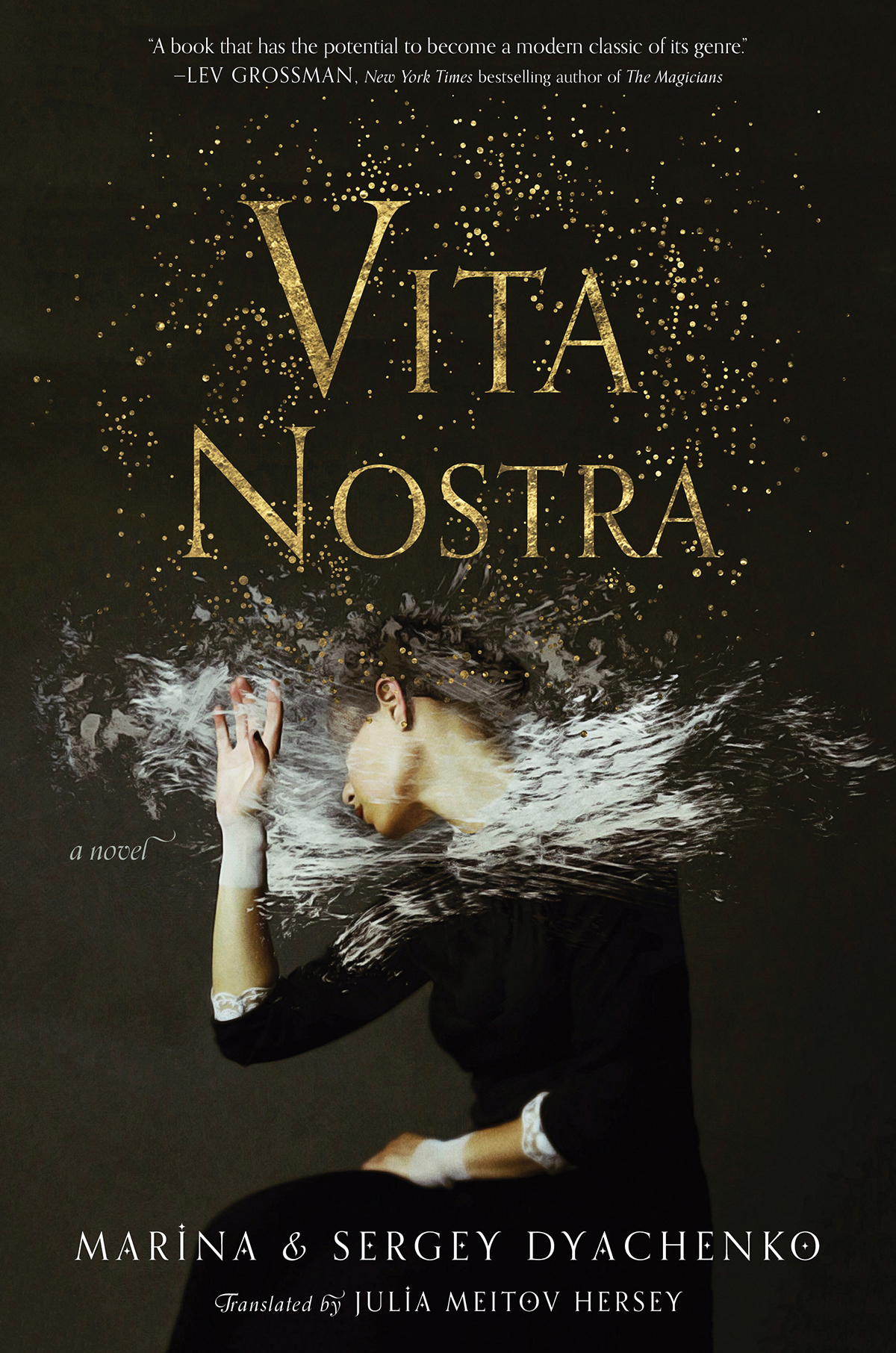
Imagine a world where logic is a hoax, where counter-intuitiveness is the norm, and truths are beyond rational comprehension. It might seem like a nightmare, but for Sasha Somakhina, the protagonist in Marina and Sergey Dyachenko’s Vita Nostra, it is her disturbing reality.
Vita Nostra is a fantasy novel, but not the Harry Potter kind of magical realism. You can’t quite compare it. No, it’s the absurd kind, the kind that tunnels the mind into a philosophical abyss and makes one question what is and what isn’t. While a magical school forms the story’s setting, it’s distinctively divergent from the gothic glory of an academy. Failure here carries dire consequences, students risk severe penalties including the deaths of their families.
And then the man stood next to her, blocking the exit, blocking her escape.“It’s a dream!” She screamed the first thing that came into her head. “I want it to be a dream!”She woke up in her foldaway bed, in tears, her ear painfully pressed against her pillow.
Sasha, only 16, is at the beginning of the novel, swimming with her mother when she notices a mysterious man following her. She fears for her safety, and he doesn’t placate her concerns when he finally speaks to her, giving his name, Farit, and a strange task: she must wake up every morning at 4:00 a.m., go down to the beach, remove her clothing, and swim. She must not be late.
“Hospital Number Six,” she chanted, like an incantation. “I’m just… I need to change, and then I’ll go. It’s a heart attack, Sasha. A heart attack. Oh god, oh god…” Like a blind person, she moved through the throng of intrigued beachgoers. Sasha watched for a second and then followed.
What if she won’t do it? Why would she? But she will. Why dangle forever between a scary dream and a real nightmare when she can perform the task asked of her and continue to live normally? The threads that hold the fabric of reality together are slowly loosening. The garment is falling apart, splaying right in front of Sasha. She does the task. It’s very important that she isn’t late. But what happens when one morning her alarm fails her? Whose life is in jeopardy? Farit is not a kind man. He intertwined terror with his affection, demanding absolute obedience. He assigns Sasha other tasks until she receives an acceptance letter to a school she never applied for in a town she’s never heard of: The Institute of Special Technologies in Torpa.
Torpa’s brutal curriculum utterly captivates Sasha eventually. She develops a spiritual love for this bizarre education. These lessons unlock something deep inside her; her intellect, initially a mystery, unfolds like origami, revealing hidden patterns with every new study. She pushes mental limits, grappling with apparent nonsense, visualizing impossible geometries, and tries to understand the universe’s grammar. Often, the reader is bemused with the unfolding strangeness. Through this process, Sasha transforms into something new, distinct, and terrifying.
Vita Nostra handles language as the magic system, going far beyond, creating a perilous feeling.
There was no hope that he would leave. She did not feel too optimistic about Mom chasing him away. Plus, how could she make any decisions regarding Mom’s fate according to her own desires? “You can call her at the office,” she said frostily. And added, a little too late, “How are you feeling?”
Sasha herself isn’t exactly the perfect character. Often blinded by her self-absorption, as seen in her relationships with her classmates and her relationship with her mother and stepfather reveals, she sometimes isn’t just a good person. She, in fact, fails to realize how she sabotages herself. But she’s young, going through changes and studies so intensely psychological that it becomes quite difficult for her to focus on anything else. She struggles with empathy, which inherently causes harm to relationships she wants to cultivate. Take, for instance, Kostya, Farit’s son, who loves her, and she him. Yet, her inability to reach out, her fear of connection, prevents her from taking the steps necessary to bridge the gap between them. She wants to reach out, to love, to connect, but she doesn’t know how. She has a strong sense of self, and it gets in the way a lot of times.
“Can you hear me?” She nodded, overwhelmed for a second by the pain within her enormous, heavy head. “As I’m sure you’ve gathered, you are not simply a verb in the imperative mood. You are Password—a key word that opens a new informational structure. Macrostructure. Do you understand what it means?” Essences around her shifted, remaining in place, flowing, turning different facets. Meanings followed in a single file. Sasha managed to grab the simplest definitions, the ones lying on the surface.
The ending of Vita Nostra is left to interpretation. She was to reverberate, become part of the great speech, but she was a command, a verb. She was not meant to conform and obey. She’s to tell the world how to be. The idea of her being a verb in the imperative mood depicts individual differences and how these differences affect our trajectories.
Click here to get the book.
Looking for book reviews or recommendations? Click here to explore.

Leave a Reply